
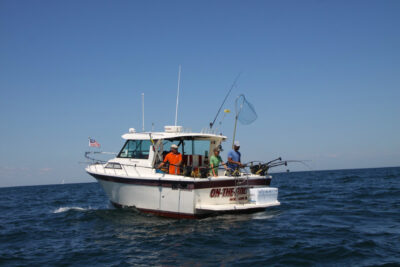
Hiring a charter boat can lead to fishing adventures that last a lifetime.
U.S. Coast Guard-licensed Charter Captains are the true ambassadors of our Lake Ontario fishery, be it for salmon and trout; walleye, bass, musky, and perch. If you don’t have a boat yourself, they can lead you to the promised water for whatever species of fish you would like to catch – and keep – if that’s your intent.
Even if you do have a boat, hiring a skipper can often offer you a short cut to catching fish if your intent is to fish multiple days for a derby, tournament, or just a family vacation and you want to increase your odds at success.
Charter captains make their living by catching fish. They need to adapt their presentations and programs every day to adjust for weather, current, fish movement, and whatever scenario may present itself when on the water.
Like the first rule of advertising, your number one consideration should be location. If you are looking for a place to fish, it could very well dictate what time of year it is. Type of fish species will probably be another important consideration based on that timeline. Weather could be an important factor that comes into play. You are not simply throwing a dart at a map of Lake Ontario to see where and when you will be going. However, every county along the south shore of the lake offers fish for the taking. Knowing where to go is key.
Cost may also be a consideration for hiring a charter captain, but like with most things in life, quite often you will get what you pay for. That’s not to say you can’t have a good time and a solid trip with someone based on price alone. However, a first-class professional operation has certain standards that must be kept. He (or she) also has expenses that cannot be compromised on such as fuel, dock space, insurance, first mate costs, regular boat maintenance, winter storage, and more that must be figured in for full or half-day charters. If someone is offering a discount or has a gimmick of “guaranteed fish,” there is usually a reason for it, and it can’t be good. And is someone is not running a mate, but their costs are equal to that of fishing business that does, ask why.
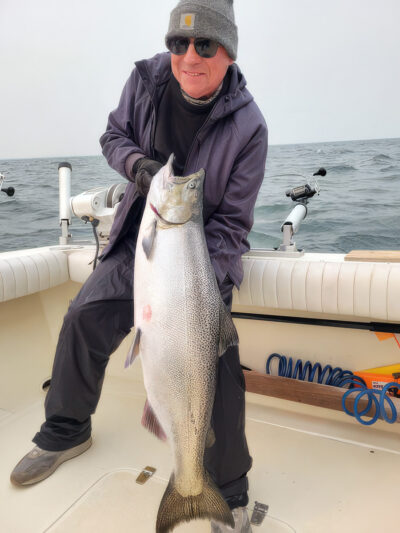
John Jarosz of Lake View, NY will charter many times a year to target spring and summer salmon with family and friends. Here he holds a 22-pound king salmon.
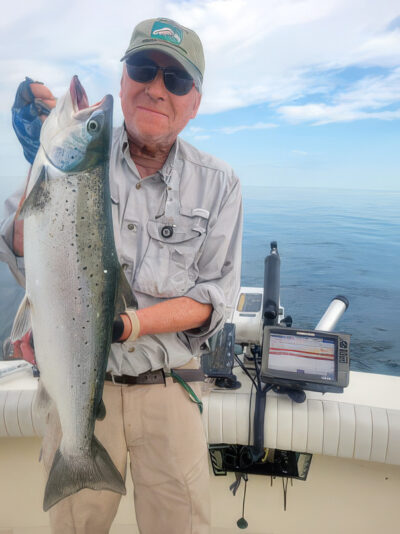
John Jarosz of Lake View, NY sold his boats and started chartering instead. Here he holds up his first Atlantic salmon caught on Lake Ontario.
John Jarosz of Lake View, NY was a boat owner for over 50 years, and he sold his boats recently to take advantage of the Empire State’s charter fleet for the Great Lakes – something he has been doing for seven years now. He hasn’t regretted it one bit.
“When I had my own boat(s), I would get the bait and load up the equipment, hook up the boat, tow it to the launch, pay the launch fee, wait in line, spend more time finding the fish than actual fishing, fish for a couple hours, wait in line to retrieve at the launch, tow back home, and then do equipment maintenance, in addition to trailer maintenance,” he said. “With a charter, the hardest thing I must do is show up on time with my lunch, water and payment. Then when I get home, package and freeze the fish. If I invite my friends along, there’s absolutely no pressure on me to catch fish.”
“If I factor in the ‘non-fishing time’ at an hourly rate that I would pay myself, chartering, to me, is much cheaper than boat ownership,” Jarosz continued. “The only thing I lose is the flexibility of not going out when I want. Being retired now, there are always other things to do, and when I do book a charter, that time is the most efficient way I can use it. When I retired, I thought I would do nothing but fish. Unfortunately, it didn’t work out that way, and I ended up fishing less than I did when I was working.”
This in no way condemns boat ownership. However, if you own a boat and enjoy fishing off it, hiring a skipper to help provide an on-water educational experience is a great option to learning the ropes – especially if you are fishing a relatively new body of water. One trip on the water will provide the essential ingredients for what the hot baits are, the best fishing depths, best tactics to use, and what species you should be your target for that time of year. You can be very specific about what you want to fish for and how you do it.
Size does matter when it comes to a charter vessel, especially if the wind plays a role in your time on the water. That should enter your discussion when interviewing a potential captain. How big is the boat, do you employ a first mate, and how are the waves on a typical fishing day for the time of year you are considering? The bigger the boat, the more comfortable you will be on the water.
Charter captains survive on repeat business. Someone who is replacing a large percentage of clients year after year should be a red flag. Don’t be afraid to ask for references from previous customers and follow through by calling them. Ask them how their experience was and whether they would re-book with that captain again.
Remember, while you are there to catch fish, the goal should be to have a good time. Look at the big picture. Establishing a relationship with a particular captain is important if repeat business is in your future.
“I don’t like to fish alone,” says Jarosz. “What am I going to do, just catch fish? I go on a charter with my sons or my friends, and we talk it up, jab each other, chat with the captains, talk about the state of fishing and have a plain old good time – without having to worry about catching a fish. Catching fish is fun, but it’s more fun paying someone else to find them. Years later, we still bring up those past fishing trips and the good laughs we had. Without a doubt, that’s the best part.”
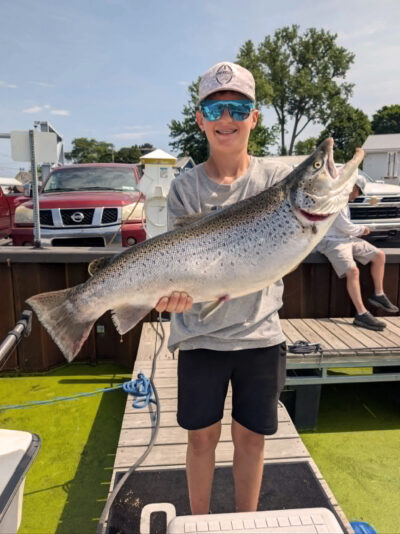
Using a charter boat to fish in the many derbies and tournaments can lead to some surprise cash in your pockets. Nolan Wolter, 13, of Lockport took over the early lead for Youth in the Summer LOC Derby with this brown trout.
There are plenty of other questions to ask when making the decision of which captain to book with: How many releases or hits can you expect on a typical day (not how many fish do you catch)? It’s still up to the customer to reel those fish to the boat and handle the equipment well enough to get those fish to the net. Do you clean our catch? Are you fully licensed and insured? How long have you been in the business (longevity should count for something)? Is your charter fishing operation sponsored by anyone (big name fishing manufacturers won’t associate themselves with questionable businesses)? What kind of boat do you operate and how big is it? Do you run out of a marina and which one? How much money are full-day and half-day trips and how long are they? How many people are those costs for and what is the charge for any extra anglers? When you do select a skipper, ask for a list of what you should bring (sunscreen, camera, beverages, food, sunglasses, and motion sickness pills to name but a few).
It is appropriate to tip the captain and/or mate after the trip. The amount should be based on your experience and how hard the captain and/or mate is working for you. Sometimes when a captain runs a mate, most of their pay is based on tips. Feel free to ask the captain how he handles the situation. How much you tip will be based on personal experience, but an average is probably around $20-25 per person just to give you an idea.
Lake Ontario is a world-class sport fishery. Hiring a qualified and experienced charter captain can help you to have a world-class fishing adventure. The Lake Ontario Sportfishing Promotion Council (www.lakeontariofishing.com) is your go-to information source for all things fishing and tourism because it represents each of the individual counties along the south shore of this Great Lake and lists the charter captains that operate out of our New York ports. A corresponding map will show the counties and where the ports are located. Take your time in selecting a skipper and it could make for a better overall experience all the way around. Good luck … and fish on!